Learning road rules in another language can involve two problems at once: understanding the rule and understanding the wording. Separate those tasks. Use Chinese to build comprehension, keep a small English glossary for unfamiliar terms, and check official exam support before you book. This guide helps you do all three without confusing app translations with the language options of the official test.
Chinese in the app is not an exam booking option
DTT Ireland’s latest Android release adds Simplified Chinese (简体中文) alongside English, Irish, Polish, Portuguese, Ukrainian, Arabic, Urdu and Romanian. Choose it in the app’s language settings. This changes your study experience; it does not contact the official booking service or change an appointment.
The official service lists Simplified Chinese among 21 voiceover languages for the BW car, tractor and work-vehicle exam. This is a specific voiceover provision, not evidence that every exam category has fully translated written questions. Source: official voiceover announcement.
Do not assume a BW language option also applies to AM motorcycle tests. Check the available options for your actual booking and ask the test service if anything is unclear.
Make a small glossary you will actually use
A personal glossary works best when it contains words that caused you difficulty, rather than a long list copied from somewhere else. Include the English term, a short Chinese memory aid and a sentence explaining the situation. These examples are study prompts, not official exam translations.
| English term | 中文学习提示 | Your next step |
|---|---|---|
| Blind spot | 盲区 | Explain where the unseen area is in a scenario. |
| Junction | 交叉路口 | Identify the layout before answering. |
| Pedestrian crossing | 人行横道 | Read the particular crossing situation. |
| Learner permit | 学习驾驶许可 | Keep this separate from a full driving licence. |
| Motorway | 高速公路 | Check the rules for the vehicle and licence involved. |
Keep the English phrase visible as you revise. A one-word translation is sometimes too broad to explain a road rule, so write down the context that made the question difficult. If you are still unsure, ask an instructor rather than relying on an automatic translation alone.
A repeatable 20-minute study session
This is a suggested routine, not a guaranteed timetable. Adjust the length to your concentration and familiarity with the topic.
- Five minutes: return to old mistakes. Read the question again before opening the explanation. Check whether yesterday’s idea still makes sense.
- Ten minutes: one focused topic. Work through a manageable set. Mark uncertain answers in your notes even when you guessed correctly.
- Five minutes: explain and record. Describe the rule in your own words and add only the most useful new terms to your glossary.
On another day, replace the topic set with mixed practice. That tests whether you can recognise the idea without knowing what theme is coming next. Keep a short log of the date, topic and one point to revisit. You do not need a complicated spreadsheet to make progress visible.
Avoid translation and memorisation traps
Read the whole question before matching a familiar word to an answer. A vehicle, road condition or qualifier can change what the question is asking. If two alternatives seem similar, explain the difference in Chinese before checking the answer.
Do not measure readiness only by the number of questions completed. Ask whether you can still explain a rule the next day and whether unfamiliar wording changes your understanding. When an explanation seems inconsistent with official guidance, pause and verify the point instead of memorising it as an exception.
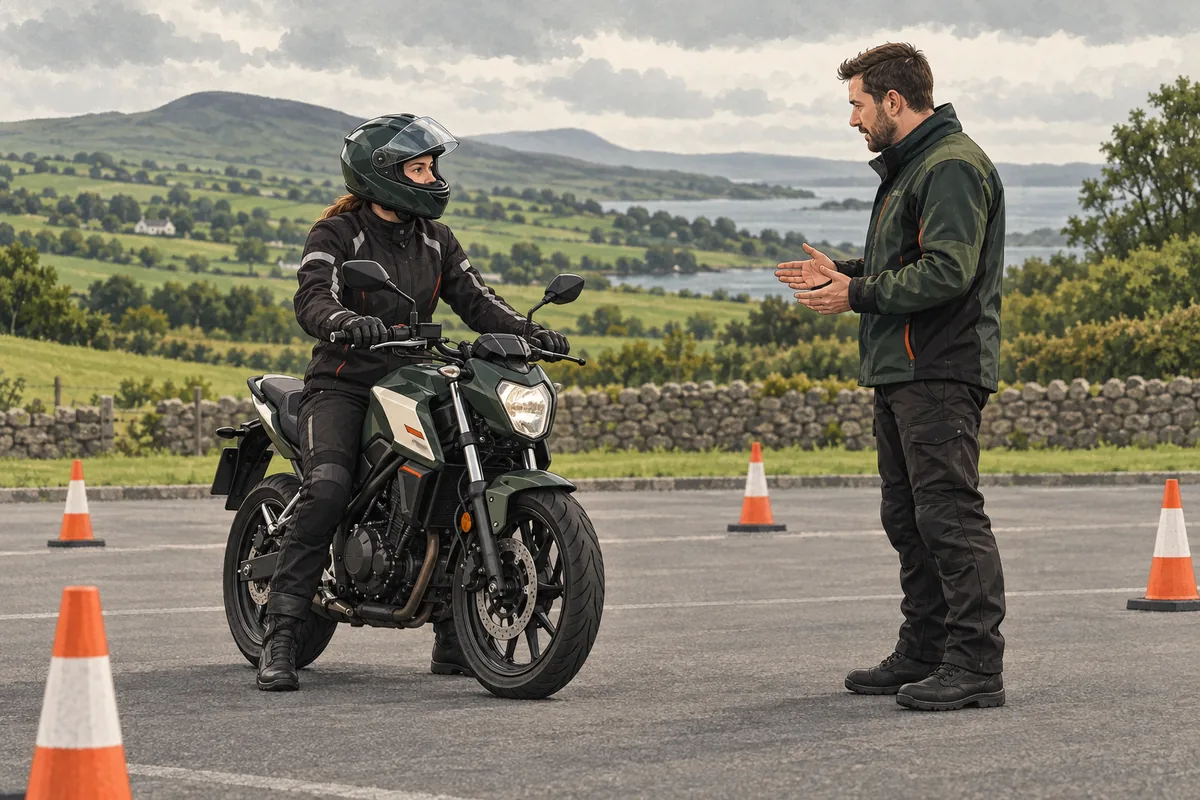
For motorcycle learners, also keep rider-specific terms together. Our motorcycle revision plan suggests a way to organise that material.
Before you confirm the official booking
Use the official theory-test booking page. Check the selected test, centre, date and any available language or assistance selection before paying. Read test-day assistance guidance if you need support; do not assume it will be added automatically on arrival.
- Does the selected exam match the vehicle category you intend to learn?
- Have you chosen the support option actually offered for that exam?
- Do the personal details match your accepted identification?
- Have you saved the confirmation and read the arrival instructions?
- Can you explain the booking details to the service if you need to contact them?
Use our official-links hub to return to the correct service later. DTT Ireland does not manage appointments or collect your booking documents.
给中文学习者的实用建议
先理解交通规则,再练习英文术语。做错题时,不要只记住答案的位置;请用自己的话说明为什么这个答案正确。第二天再复习一次,检查自己是否真正理解。
应用中的简体中文学习内容,与正式考试的语音辅助选项是两回事。预约时,请在官方网站确认考试类别、考试地点、证件要求及可用的语言支持。不要因为应用里可以选择中文,就认为正式考试的所有类别都提供相同的服务。
如果一个词或一道题让你困惑,请把英文原词、中文解释和具体情境记在一起。对于会影响实际驾驶的规则,请向教练或官方机构核实。
Common questions
Does the app book a Chinese theory test for me?
No. Select and confirm any official language support through the official test booking service.
Does the official Chinese voiceover cover motorcycle exams?
The announcement cited here is for BW. Check AM motorcycle support directly with the official service; do not infer availability from the app.
Is the Chinese option Simplified or Traditional?
The app’s new language option is Simplified Chinese.
Should I revise only in English?
Use a language that helps you understand the rule, while keeping useful English terms in your notes. Choose the official exam support that is available and suitable for you.
Check the official guidance
Official information checked on 28 September 2026. Study routines and preparation checklists are DTT Ireland’s suggestions. Confirm current requirements with the relevant service before booking.
Spotted an outdated detail? Tell us which guide and section.
Your next study session starts here.
Car and motorcycle practice, with nine study languages in the latest Android app.