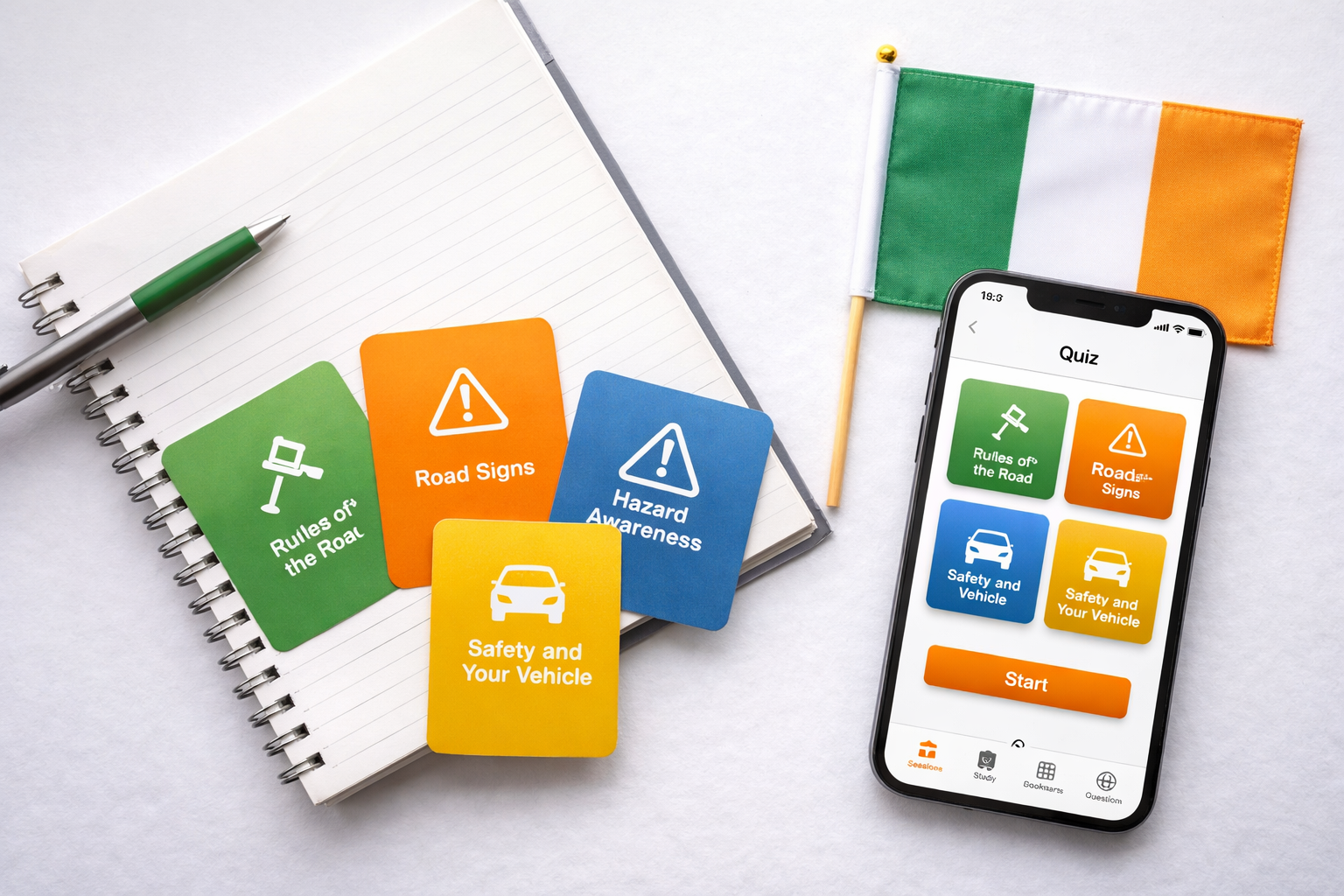
The RSA driving theory test draws questions from 8 distinct categories. Understanding what each category covers—and how many questions you'll face—is the first step to strategic, efficient study. This guide breaks down all 8 categories with the exact topics tested, difficulty level, and expert tips for each section.
The test contains 40 questions total, drawn randomly from a bank of 805 questions. The distribution across categories remains consistent: you'll get roughly 22% Rules of the Road, 18% Traffic Signs, 17% Safe Driving, 13% Vehicle Safety, 11% Driver Attitudes, 9% Vulnerable Road Users, 6% Environment, and 4% First Aid.
Question Distribution Across RSA Theory Test Categories
Out of 40 questions per test, this pie chart shows the approximate distribution. Each test is randomly selected, so exact numbers vary slightly.
Rules of the Road
Speed limits, road markings, junctions, overtaking, priorities
Key Facts to Memorise
- Speed limits: 50 kph in built-up areas (signs say so), 80 kph on roads without street lighting, 100 kph on motorways, 80 kph for learner drivers
- Road markings: Single solid white = no overtaking. Broken white = overtaking allowed. Yellow lines control parking, not traffic flow
- Right of way at junctions: Yield to traffic from the right, unless a give way/stop sign says otherwise
- Overtaking rules: Only overtake on the left, never on the right. Never overtake at bends, hills, or near intersections
- Pedestrian crossings: Give way at all marked crossings (zebra, pelican, puffin). Yield to pedestrians stepping out
Common Mistake
Learners often miss questions about speed limits by speed in special conditions. For example: "What's the speed limit on a road without street lighting outside a built-up area?" Answer: 80 kph. But if you're asked about a specific speed sign showing 60 kph, that overrides the general rule.
DTT Ireland Study Tip
Use the "Rules of the Road" timed practice mode in DTT Ireland to build speed and accuracy. This category has high question volume, so drilling it improves your overall test time management.
Traffic Signs
Warning signs, regulatory signs, information signs, directional signs
Key Facts to Memorise
- Red triangles: Warning signs (pedestrian crossing, slippery road, sharp bend, road works)
- Red circles: Prohibitions (no entry, no parking, no overtaking)
- Blue circles: Mandatory instructions (keep right, go straight, turn left)
- Rectangular signs: Information (parking, bus stop, hospital)
- Diamonds (yellow background): Minor road warning signs (e.g., sharp curve ahead)
Common Mistake
Confusing warning signs (red triangle) with mandatory signs (blue circle). A red triangle with a pedestrian tells you "pedestrians ahead" (warning). A blue circle with a figure tells you "compulsory direction" (mandatory). The shape and colour are always the key.
DTT Ireland Study Tip
Use DTT Ireland's sign image gallery. Study signs grouped by type (warnings, mandatory, etc.) rather than memorising each one individually. Visual memory works better for traffic signs than verbal description.
Safe Driving
Following distance, night driving, fog, motorway rules, reversing
Key Facts to Memorise
- 2-second rule: Keep at least 2 seconds behind the car ahead. Count: 1, 2 after they pass a fixed point
- Fog driving: Use dipped beams and fog lights. Full beams bounce off fog droplets, worsening visibility
- Motorway limits: 100 kph for ordinary licence holders. Learner drivers: 80 kph (and must have a supervising driver)
- Hazard lights: Use at low speed on motorways when broken down or in an emergency
- Reversing: Never reverse onto a main road. Reverse slowly and use mirrors constantly
Common Mistake
Learners often forget that the 2-second rule applies at all speeds. At 60 kph it's roughly 50 metres, but at 100 kph it's over 55 metres. The rule is the time, not a fixed distance.
DTT Ireland Study Tip
Practise the 2-second rule on real roads. This embeds the feeling and makes the rule stick better than reading alone. DTT Ireland's "Safe Driving" focus mode drills all these scenarios.
Vehicle Safety
Tyres, lights, brakes, mirrors, towing, load securing
Key Facts to Memorise
- Tyre tread depth: Legal minimum 1.6mm across the central three-quarters of the tyre width
- Brake lights: Red lights at rear that illuminate when braking. Broken = danger
- Mirrors: Check all three (interior, left, right) regularly. Adjust before driving
- Load securing: Use cross-straps, edge protection, and ensure nothing can shift or fall
- Fog lights: Use only in fog or heavy rain. Turn off in normal conditions (they distract other drivers)
Common Mistake
Forgetting the exact tyre tread depth (1.6mm). Also confusing brake lights (red, mandatory) with fog lights (red/yellow, only for fog).
DTT Ireland Study Tip
Walk around a real car and inspect each component. Check the tyres, lights, and mirrors. This hands-on practice anchors the visual memory better than reading.
Driver Attitudes
Drink driving, drug driving, mobile phone, fatigue, emotions
Key Facts to Memorise
- BAC limits: Learner permit 0.02%, ordinary licence 0.05%, young drivers (17–23) varies by region
- Mobile phone ban: Even at red lights. €250 fine and penalty points
- Drug driving: Any drug impairs. Testing is done by blood or breath (roadside drug test exists)
- Fatigue: Take breaks every 2 hours on long journeys. Stop if too tired
- Emotions: Anger, distraction, and stress increase crash risk. Remain calm
Common Mistake
Confusing BAC limits. Learner drivers (0.02%) have a much stricter limit than ordinary licence holders (0.05%). Know which applies to you.
DTT Ireland Study Tip
Create a flashcard with BAC limits, mobile phone fines, and fatigue rules. Drill this card daily. These are high-value facts that appear frequently on tests.
Vulnerable Road Users
Cyclists, pedestrians, motorcyclists, children, elderly, disabled
Key Facts to Memorise
- Cyclist clearance: 1 metre at speeds under 50 kph, 1.5 metres above 50 kph
- Zebra crossings: Give way to pedestrians already crossing. Slow down and be prepared to stop
- School zones: Reduced speed limits apply. 30 kph or as posted. Extra caution around school times
- Motorcyclists: May be hidden in blind spots. Check mirrors carefully. Don't cut them off
- Elderly and disabled: May move slowly or unpredictably. Give extra time and space
Common Mistake
Guessing at the exact cyclist clearance distance. Remember: 1m under 50 kph, 1.5m above. This is precise and frequently tested.
DTT Ireland Study Tip
This is the hardest category. Use DTT Ireland's "Vulnerable Road Users" focus mode heavily. The app's spaced repetition will drill these specific figures until they're automatic.
Environment
Eco-driving, fuel efficiency, emissions, tyre pressure
Key Facts to Memorise
- Underinflated tyres: Increase fuel consumption (3–5%), emissions, and wear
- Efficient speeds: 100–110 kph on motorways yields best fuel economy
- Idling: More than 10 seconds wastes more fuel than restarting the engine
- Aggressive acceleration: Increases emissions and fuel use significantly
- Eco-driving benefits: Lower fuel costs, reduced emissions, safer driving overall
Common Mistake
Learners sometimes think eco-driving is slow driving. Actually, it's smooth, steady driving at moderate speeds. It's both cheaper and safer.
DTT Ireland Study Tip
Link environment questions to personal benefit. Lower fuel use = lower cost. This helps you remember the rules with practical motivation.
First Aid
Crash scene, injured persons, recovery position, CPR
Key Facts to Memorise
- Crash scene first: Turn off the engine, put on hazard lights, make the area safe
- Recovery position: Turn unconscious (but breathing) person on their side. Tilt head back to open airway
- Don't move: Never move an injured person unless they're in immediate danger (e.g., fire)
- Motorcycle helmet: Don't remove unless it blocks the airway
- Call emergency: Always call 999 or 112 for serious injuries
Common Mistake
Moving an injured person when you shouldn't (risk of spinal injury). Unless they're in immediate danger, keep them still and call emergency services.
DTT Ireland Study Tip
Watch a video on first aid and recovery position. Then take a real first aid course (2 hours). This knowledge could save a life, and the hands-on practice makes the test questions easy.
Quick Reference: All 8 Categories at a Glance
| Category | % of Test | Questions | Difficulty |
|---|---|---|---|
| Rules of the Road | 22% | ~9 | ⭐⭐ |
| Traffic Signs | 18% | ~7 | ⭐⭐ |
| Safe Driving | 17% | ~7 | ⭐⭐⭐ |
| Vehicle Safety | 13% | ~5 | ⭐⭐⭐ |
| Driver Attitudes | 11% | ~4 | ⭐⭐⭐ |
| Vulnerable Road Users | 9% | ~4 | ⭐⭐⭐⭐ |
| Environment | 6% | ~2 | ⭐⭐ |
| First Aid | 4% | ~2 | ⭐⭐⭐⭐ |